

Fundamental Principles Enabling Small Organizations to Benefit from AI
AI is omnipresent. In the wake of ever-changing developments within Information Technology, the emergence and growing omnipresence of AI will impact future business operations of SMEs. This is why an AI Governance Framework (AIGF) is a helpful tool for assisting SMEs in their adaptation with AI. Consequently, what types of AI usages within SMEs need a governance framework? Our Cybersecurity Newsletter has been carefully written to answer this question. Designated at the end of this document, the Resources and References 1 to 16 have been duly accessed, circumspectly analyzed, broadly summarized and methodically adjusted for the writing of the 7 sections and subsections of this cybersecurity manuscript.
Our cardinal question: What are the types of AI usages within SMEs that need a governance framework? A surprisingly large slice of AI usage inside SMEs requires a governance framework — not because SMEs need bureaucracy but because AI introduces new operational, legal, and reputational risks that can quietly accumulate. The simplest way to think about it is this: Any AI usage that affects decisions, data, customers, employees, and compliance needs a governance framework.
SECTION I
SUMMARIZED CLARIFICATIONS OF DIFFERENT AI ARCHITECTURE MODELS USED BY ORGANIZATIONS INCLUDING SMEs
The chosen AI model architecture has a direct impact on the governance framework, risk profile, and control requirements. Governance is generally simpler when an organization uses a commercial enterprise version of ChatGPT or a similar managed AI service, as many security, infrastructure, maintenance, and compliance responsibilities remain with the vendor. In contrast, when an organization develops, fine-tunes, or operates its own AI models, it assumes significantly greater responsibility for data governance, model oversight, security controls, regulatory compliance, monitoring, and lifecycle management. Furthermore, many organizations are now embedding AI capabilities directly into their products and services. In numerous cases, these solutions rely on limited domain-specific training, retrieval-based approaches, or specialized knowledge models that have a relatively low governance impact compared with fully trained proprietary models. Nevertheless, governance requirements increase when AI systems influence customer decisions, process sensitive information, or operate with a high degree of autonomy.
1. Outsourced AI (SaaS)
Model location: Runs entirely on an external provider’s infrastructure (Microsoft, OpenAI, Google, Anthropic, etc.)
Training: Pretrained by the vendor SME data usage. Depends on vendor policy Data retention:
- Enterprise-grade offerings (e.g.: Google Gemini, ChatGPT, Microsoft Copilot, Azure OpenAI) → no customer data is used to train the model
- Consumer-grade offerings → may use data for model improvement unless opted out
Characteristics
- No infrastructure burden
- Fastest adoption
- Strong compliance if using enterprise-tier services
- Risk depends on vendor’s data-handling guarantees
Best for: SMEs without ML teams; rapid deployment; low operational overhead.
2. Internal Use of External Models (Private Cloud / VPC Deployment)
Model location: Vendor model deployed inside the SME’s private cloud or virtual private environment
Training: Usually not retrained; sometimes fine-tuned SME data usage:
- Data stays inside SME’s controlled environment
- Vendor does not retain or learn from SME data
Characteristics
- Higher security and compliance
- Allows integration with internal systems
- More expensive than public cloud usage
Best for: Regulated industries (finance, healthcare), sensitive data environments.
3. In‑House Training (Fully Internal Models)
Model location: Entirely on SME infrastructure
Training: SME trains the model from scratch or using open-source architectures SME data usage:
- All training data is controlled internally
- No external retention
- Full governance responsibility lies with the SME
Characteristics
- Maximum control
- Highest cost and complexity
- Requires ML engineers, GPU clusters, MLOps pipelines
Best for: Large enterprises, defense, advanced tech companies.
4. External Training Using SME Data (Vendor‑Trained or Co‑Trained Models)
This is the most misunderstood category — and the one with the highest governance risk.
Model location: Vendor infrastructure
Training: Vendor trains or fine-tunes a model using SME-provided data SME data usage: two (2) sub‑models exist:
4A. SME Data Retained for Vendor Training
- Vendor keeps the data
- Data may be used to improve the vendor’s general models
- Risk: loss of competitive advantage, IP leakage, compliance exposure
4B. SME Data Excluded from Vendor Training
- Vendor uses SME data only for the SME’s private fine‑tuned model
- Data is not used to train global models
- Data is deleted or isolated after training
- Common in enterprise contracts with strict DPAs
Characteristics
- Highly customized performance
- Requires strong contractual controls
- Must include: retention clauses, deletion guarantees, model-isolation guarantees
Best for: SMEs needing domain-specific AI (legal, medical, engineering, proprietary workflows).
FIGURE 1: Summary Table (Architecture vs. Training vs. Data Retention)
|
Models Typology |
Where Does AI Operate? |
Who Does the Training of AI? |
Are SME Data Used for Training AI? |
Are SME Data Retained? |
| Outsourced AI | Vendor cloud | Vendor | No (enterprise tier) / Yes (consumer tier) | Depends on vendor |
| Internal Use of External Models | SME private cloud | Vendor (pretrained) | No | No |
| In‑House Training | SME infrastructure | SME | Yes | Internal only |
| External Training with SME Data | Vendor cloud | Vendor or joint | Yes | Retained or excluded depending on contract |
Non‑Obvious Insight
The AI Architecture Model does practically determine your AI risk posture more than the model type (Transformer, LLM, etc.). For the daily realities of SMEs, the biggest governance mistake is assuming “fine‑tuning” and “training” are the same.
In reality “fine‑tuning” and “training” are not the same:
- Fine‑tuning → AI architecture model learns patterns but does not absorb raw data.
- Training → AI architecture model weights change based on your data, potentially embedding proprietary information.
This distinction is critical in procurement and DPAs.
SECTION II
TYPES OF AI USAGES WITHIN SMEs NEEDING AN AI GOVERNANCE FRAMEWORK
1. AI that touches customer data
This is the highest‑risk category for SMEs.
- Customer support chatbots using CRM data
- AI‑assisted sales tools that analyze customer profiles
- Automated marketing personalization
- AI‑driven credit, eligibility, or risk scoring
Why is an AI Governance Framework needed? Privacy laws (PIPEDA, Quebec Law 25, GDPR), consent, data minimization, auditability, and preventing biased or opaque decisions.
2. AI that processes internal or sensitive business data
This includes anything that ingests proprietary information.
- Document summarization of contracts, proposals, financials
- AI‑assisted coding tools with access to internal repos
- AI‑powered analytics on operational or financial datasets
- AI used in HR processes (screening, performance analysis)
Why is an AI Governance Framework needed? Data leakage prevention, confidentiality controls, model‑output validation, and clear boundaries on what can be uploaded to external systems.
3. AI that automates or influences decision‑making
Whenever AI outputs drive actions, you need oversight.
- Automated invoice processing and approvals
- AI‑based procurement recommendations
- Inventory forecasting and supply‑chain optimization
- AI‑assisted hiring or promotion recommendations
Why is an AI Governance Framework needed? Human‑in‑the‑loop requirements, accountability, audit trails, and bias monitoring.
4. AI used for external communication
Because it affects brand, reputation, and legal exposure.
- AI‑generated marketing content
- AI‑drafted emails, proposals, or legal‑adjacent documents
- AI‑generated product descriptions or website content
Why is an AI Governance Framework needed? Accuracy checks, copyright compliance, tone/brand consistency, and preventing hallucinated claims.
5. AI used in cybersecurity or IT operations
These tools are powerful but can cause cascading failures if misconfigured.
- AI‑driven threat detection
- Automated patching or remediation tools
- AI‑based identity or access‑risk scoring
Why is an AI Governance Framework needed? Change‑control processes, monitoring, and validation of automated actions.
6. AI used by employees for productivity
This is the most underestimated risk area.
- General‑purpose AI (office operations, coding, design)
- AI note‑takers in meetings
- AI transcription and translation tools
Why is an AI Governance Framework needed? Clear acceptable‑use rules, data‑handling boundaries, and training on what not to feed into AI systems.
7. AI used in products or services delivered to customers
If your SME embeds AI into what it sells, governance becomes essential.
- AI‑enhanced SaaS features
- AI‑powered analytics offered to clients
- AI‑based recommendations inside customer‑facing apps
Why is an AI Governance Framework needed? Transparency, reliability, service‑level expectations, and liability management.
8. AI used for compliance‑relevant tasks
If AI touches regulated processes, governance is mandatory.
- Financial reporting assistance
- AI‑supported legal research
- AI used in safety‑critical workflows
Why is an AI Governance Framework needed? Validation, documentation, and ensuring AI does not replace required human judgment.
9. AI used for code generation by many organizations including SMEs
AI used for code generation is built on large language models (LLMs) that have been trained on massive corpora of source code, documentation, and natural language. The core idea is simple: the model learns statistical patterns in how code is written, structured, and explained — then uses those patterns to generate new code, fix bugs, or suggest improvements.
What Are Actually AI Code Generators?
They are transformer-based AI models (such as Google Gemini, GPT-style models, Microsoft Copilot, Code Llama, StarCoder) specialized for programming tasks. They operate by predicting the next token in a sequence — but those tokens can be:
- Keywords (if, class, return)
- Variable names
- Entire functions
- Comments and documentation
- Configuration files
- Test cases
This makes those AI Code Generators capable of producing everything from small snippets to full modules.
How Do AI Code Generators Function Operationally?
- You provide context
- A comment
- A partially written function
- A bug
- A natural-language request
- The model analyzes the context It uses attention mechanisms to understand dependencies, variable scope, libraries, and patterns.
- It predicts the most likely continuation This could be a line of code, a block, or a full implementation.
- It refines output using natural-language reasoning Modern code models combine code understanding with general reasoning, enabling:
- refactoring
- optimization
- security suggestions
- documentation generation
What Are AI Generators Trained On?
- Public open-source repositories
- Programming textbooks and documentation
- Issue trackers, and Q&A forums
- Synthetic code generated during training
Enterprise-grade systems do not train on private customer code unless explicitly contracted.
Why Are AI Code Generators Useful?
- Accelerate development
- Reduce boilerplate
- Improve consistency
- Catch bugs early
- Help junior developers learn patterns
- Assist senior developers with repetitive tasks
AI Code Generators do not replace Computer Engineers — they complement them.
The Non‑Obvious Insight
The biggest AI Governance failures in SMEs do not come from advanced AI systems — they come from employees casually pasting sensitive data into general‑purpose AI tools. That is why an AI Governance Framework (AIGF) must cover both enterprise‑level AI systems and everyday employee usages.
FIGURE 2 – Summary Table: What Type of AI Usage Needs an AI Governance Framework?
| AI Usages Categories | Why They Need Governance | Typical SMEs Examples |
| Customer data | Privacy, bias, consent | Chatbots, sales AI |
| Internal sensitive data | Confidentiality, leakage | Contract summarization |
| Decision automation | Accountability | Procurement, HR |
| External communication | Reputation, accuracy | Marketing content |
| Cybersecurity AI | Operational risk | Threat detection |
| Employee productivity AI | Data misuse | Copilots, note‑takers |
| AI in products/services | Liability | SaaS features |
| Compliance‑related AI | Regulatory exposure | Financial reporting |
SECTION III
SAMPLE OF A POLICY-DRIVEN & PRESCRIPTIVE AI GOVERNANCE FRAMEWORK FOR SMEs
Below is a sample of an AI Governance Framework (AIGF) tailored for SMEs. This is a policy-driven and prescriptive AIGF for the benefits of SMEs.
AI Governance Framework (AIGF): Sample AIGT for a Small and Medium‑Sized Enterprise (SME)
Policy-Driven & Prescriptive
1. Purpose
This AIGF establishes mandatory rules for the safe, compliant, and responsible use of Artificial Intelligence (AI) systems within the organization.
This AIGF applies to all employees, contractors, subcontractors, vendors, and third parties who access company systems or data.
2. Scope
This AIGF governs all AI usage, including:
- Generative AI tools (text, image, audio, code, video)
- Predictive analytics and machine‑learning models
- AI‑enabled automation tools
- AI embedded in third‑party software
- AI used in customer‑facing products or services
3. Definitions
- AI System: Any software that generates, predicts, recommends, or automates outputs using machine learning or large language models.
- Sensitive Data: Customer data, employee data, financial data, proprietary information, or regulated data.
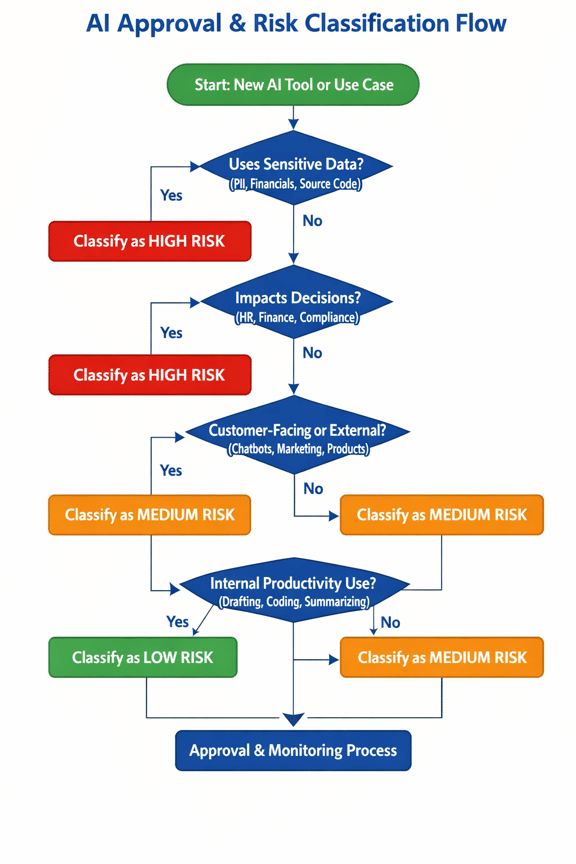
- High‑Risk AI Usage: Any AI activity that influences decisions, processes sensitive data, or impacts customers or employees.
4. AI Governance Principles (Mandatory)
4.1 Human Accountability
- AI may assist, but may not replace human judgment in decisions involving customers, employees, finances, legal matters, or compliance.
- A named human owner must be assigned to every AI system.
4.2 Transparency
- Employees must disclose when AI is used to generate external‑facing content.
- Customers must be informed when interacting with AI systems.
4.3 Data Protection
- No sensitive data may be entered into external AI tools unless explicitly approved by IT and Legal.
- All AI systems must comply with GDPR, PIPEDA, and applicable privacy laws.
4.4 Auditability
- AI‑generated decisions must be traceable, reviewable, and reproducible.
- Logs must be retained for a minimum of 12 months.
5. Prescriptive Rules by AI Usage Category
5.1 AI That Touches Customer Data
Prohibited:
- Uploading customer data into public AI tools.
- Using AI to make automated eligibility, credit, or risk decisions without human review.
Required:
- Use only IT‑approved AI platforms with data‑processing agreements.
- Maintain audit logs of all AI‑assisted customer interactions.
- Conduct quarterly bias and accuracy reviews.
5.2 AI That Processes Internal or Sensitive Business Data
Prohibited:
- Entering contracts, financials, source code, or proprietary documents into unapproved AI systems.
- Using AI to summarize or analyze confidential documents without encryption.
Required:
- All internal data processed by AI must be stored on company‑approved systems.
- Outputs must be validated by a subject‑matter expert before use.
- Access must follow least‑privilege principles.
5.3 AI That Automates or Influences Decision‑Making
Prohibited:
- Fully automated decisions in HR, finance, procurement, or compliance.
- Deploying AI automation without IT change‑management approval.
Required:
- Human‑in‑the‑loop review for all decisions affecting people or finances.
- Documented decision criteria and escalation paths.
- Annual model validation and drift testing.
5.4 AI Used for External Communication
Prohibited:
- Publishing AI‑generated content without human review.
- Using AI to generate legal, medical, or regulatory claims.
Required:
- All AI‑generated marketing, sales, or public content must be reviewed by Communications.
- AI outputs must be checked for accuracy, copyright, and brand alignment.
- Disclose AI involvement when required by law or industry norms.
5.5 AI Used in Cybersecurity or IT Operations
Prohibited:
- Allowing AI tools to autonomously execute remediation actions without IT approval.
- Using unverified AI tools for code generation in production systems.
Required:
- AI‑driven alerts must be reviewed by IT Security before action.
- Automated patching must follow change‑control processes.
- Security logs must be monitored for AI‑generated anomalies.
5.6 AI Used by Employees for Productivity
Prohibited:
- Entering confidential meeting notes, customer details, or employee information into general‑purpose AI tools.
- Using AI to generate performance reviews or disciplinary documentation.
Required:
- Employees must complete annual AI‑usage training.
- AI may be used for drafting, brainstorming, and summarization only with non‑sensitive data.
- Supervisors must monitor AI usage for compliance.
5.7 AI Embedded in Products or Services Delivered to Customers
Prohibited:
- Deploying AI features without QA testing and security review.
- Using third‑party AI models without licensing verification.
Required:
- Provide customers with clear documentation on AI functionality.
- Maintain SLAs for AI reliability and fallback mechanisms.
- Conduct annual risk assessments for customer‑facing AI.
5.8 AI Used in Compliance‑Relevant Tasks
Prohibited:
- Using AI to generate financial statements, regulatory filings, or legal interpretations without expert review.
Required:
- All compliance‑related AI outputs must be reviewed and approved by the responsible department.
- Maintain documentation of AI involvement in regulated workflows.
6. Data Handling Requirements
6.1 Allowed Data
- Public information
- Non‑sensitive internal drafts
- Synthetic or anonymized datasets
6.2 Restricted Data (Requires Approval)
- Internal financial data
- Operational metrics
- Non‑public product information
6.3 Prohibited Data
- Customer personal data
- Employee personal data
- Source code
- Legal documents
- Confidential contracts
7. Vendor and Tool Approval
- All AI tools must be approved by IT and Legal.
- Vendors must provide:
- Data‑processing agreements
- Security certifications (SOC 2, ISO 27001)
- Model transparency documentation
8. Monitoring and Enforcement
- IT will monitor AI usage logs and access patterns.
- Violations may result in:
- Mandatory retraining
- Suspension of AI access
- Disciplinary action up to termination
9. Incident Response
If an AI system produces harmful, biased, or incorrect output:
- Stop using the system immediately.
- Report the incident to IT Security within 24 hours.
- Document the input, output, and impact.
- IT will conduct a root‑cause analysis and remediation plan.
10. Review Cycle
This AIGF will be reviewed annually or upon major regulatory or technological changes.
Summarized on next page is a flowchart showing AI approval and risk classification steps.
SECTION IV
SAMPLE OF A LIGHTWEIGHT AI GOVERNANCE FRAMEWORK FOR STARTUPS (NIST-ALIGNED)
1. Purpose
To ensure:
- Responsible, transparent, and secure use of AI technologies
- Robust cybersecurity governing design and development of AI technologies.
- Maintenance protection of AI technologies agility and innovation.
2. AI Governance Structure
|
Roles |
Responsibilities |
|
AI Lead / CTO |
Oversees all AI use and ensures compliance with internal policy. |
|
Data Steward |
Manages data quality, privacy, and ethical use. |
|
Founder / CEO |
Approves high‑risk AI deployments and external communications. |
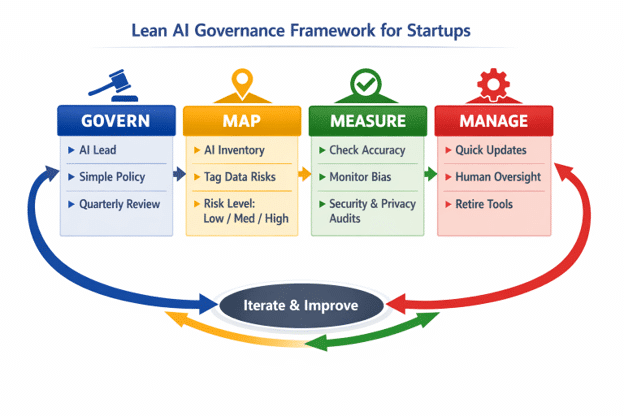
N.B.: NIST Alignment: GOVERN — Establish accountability and oversight.
3. AI Usage Policy
- All AI tools must be registered in a simple internal log.
- Employees must not upload sensitive data (PII, financials, contracts) into external AI systems.
- AI outputs used in customer‑facing materials must be human‑reviewed.
- Any new AI use case must undergo a risk check before deployment.
N.B.: NIST Alignment: MAP — Identify and categorize AI systems and data flows.
4. Risks Classification
|
Risk Levels |
Descriptions |
Approvals Required |
|
Low |
Internal productivity tools (e.g., summarization, drafting) | Team Lead |
|
Medium |
Customer‑facing but non‑sensitive AI | AI Lead |
|
High |
Sensitive data or decision‑impacting AI | CEO / Legal Review |
N.B.: NIST Alignment: MEASURE — Assess and validate risk and performance.
5. Operational Controls
- Bias & Accuracy Checks: Quarterly sampling of AI outputs.
- Privacy & Security: Encryption and vendor compliance (SOC 2 / ISO 27001 preferred).
- Incident Reporting: Any AI malfunction or data leak reported within 24 hours.
- Human Oversight: Critical decisions always require human validation.
N.B.: NIST Alignment: MANAGE — Monitor, mitigate, and continuously improve.
6. Continuous Improvement
GOVERN → MAP → MEASURE → MANAGE → GOVERN
- Review AI systems annually.
- Update policies as regulations evolve.
- Retire outdated or non‑compliant AI tools.
7. Key Startup Principles
- Keep governance light but real — one owner, one document, one review cycle.
- Focus on transparency, accountability, and agility.
- Scale the framework as the company grows.
SECTION V
AI Governance Framework – Employee Acknowledgment & Compliance Template
SMEs Version
Purpose
This form confirms that the employee understands and agrees to comply with the organization’s AI Governance Framework (AIGF), which ensures honest, responsible, ethical, and secure usage of Artificial Intelligence (AI) systems and technologies within the company.
Employee Declaration
I, ———————————- (Full First Name & Family Name), hereby acknowledge that:
- I have carefully read and duly understood the company’s AI Governance Policy and related requirements and procedures.
- I will use AI tools and systems responsibly, in accordance with company standards and applicable laws.
- I will not input or share sensitive data (personal, financial, confidential, or proprietary) into any AI system unless explicitly authorized.
- I will ensure that all AI‑generated outputs are reviewed and validated before external use or publication.
- I will report immediately any AI‑related incident (bias, malfunction, data breach, or ethical concern) to my supervisor or the AI Governance Officer.
- I understand that non‑compliance may result in disciplinary action as outlined in the company’s AI Governance Policy.
- I commit to participate in annual AI awareness training and updates provided by the organization.
Employee Information
|
Fields |
Details |
|
Name |
|
|
Department |
|
|
Position |
|
|
Date |
|
|
Signature |
SECTION VI
TRAINING, AWARENESS & CULTURE OF AI GOVERNANCE FRAMEWORK FOR SMEs
Training, Awareness & Culture for an SME AI Governance Framework Takeaway
For SMEs, the real differentiator in safe and effective AI adoption is not technology—it is people. A strong AI governance culture ensures employees understand how to use AI responsibly, avoid risks, and recognize when to escalate issues. Training and awareness turn governance from a policy document into daily behavior.
Executive Summary
SMEs need a culture where:
- Employees understand AI risks
- Leaders model responsible AI behavior
- Teams follow consistent procedures
- Everyone knows what is allowed, what is prohibited, and why
This requires three pillars:
- Training – skills and knowledge
- Awareness – communication and reinforcement
- Culture – leadership, norms, and accountability
Together, they create a workforce that uses AI confidently, safely, and ethically.
1. Training Programs (Role‑Based & Lightweight)
SMEs do not need enterprise‑scale training programs. They need targeted, role‑specific modules that can be delivered in short, high‑impact sessions.
1.1 Core Training for All Employees
This covers:
- What AI is and how it works (non‑technical)
- Acceptable Use Policy (AUP)
- Data classification (what can/cannot be shared with AI)
- Privacy basics (PII, sensitive data, retention)
- Recognizing AI hallucinations
- How to report issues or incidents
Outcome: Every employee becomes a safe AI user.
1.2 Specialized Training for Key Roles
Process Owners
- Human‑in‑the‑loop responsibilities
- Output verification
- Escalation procedures
Technical Staff (Engineers, Analysts)
- Model testing, bias evaluation
- Data governance
- Monitoring and drift detection
Leadership
- AI risk appetite
- Strategic alignment
- Accountability and oversight
Outcome: Each role understands its governance responsibilities.
1.3 Annual Refresher Training
- Updated regulations (EU AI Act, privacy laws)
- New risks (prompt injection, vendor drift)
- Lessons learned from incidents
Outcome: Continuous improvement and regulatory alignment.
2. Awareness Mechanisms (Reinforcement & Communication)
Training is not enough—SMEs need ongoing awareness to keep AI governance top‑of‑mind.
2.1 Monthly AI Governance Bulletins
Short updates covering:
- New AI tools approved
- Policy changes
- Incident summaries (sanitized)
- Tips for safe AI usage
2.2 Visual Reminders
- Posters near workstations
- “Do not paste sensitive data into AI tools” reminders
- Quick‑reference cards for data classification
2.3 AI Governance Portal (Lightweight)
A simple SharePoint/Confluence page containing:
- Policies
- Intake forms
- Training materials
- AI Inventory
- Incident reporting form
Outcome: Employees always know where to find authoritative guidance.
3. Culture of Responsible AI (Leadership & Norms)
Culture is the hardest part—and the most important. SMEs need leadership that models responsible AI behavior and reinforces norms.
3.1 Leadership Modeling
Leaders must:
- Use AI responsibly
- Follow the same AUP as staff
- Avoid “shadow AI”
- Encourage transparency and reporting
3.2 Psychological Safety for Reporting
Employees must feel safe to report:
- AI errors
- Bias concerns
- Data misuse
- Unexpected model behavior
No blame—only learning.
3.3 Embedding AI Governance into Daily Workflows
- Intake forms integrated into procurement
- Data classification integrated into onboarding
- AI risk checks integrated into project planning
Governance becomes a habit, not a hurdle.
FIGURE 5: Summary Table — Training, Awareness & Culture
| Domains | Key Elements | Outcomes |
| Training | Core training, role‑based modules, annual refreshers | Skilled, responsible AI users |
| Awareness | Bulletins, reminders, governance portal | Continuous reinforcement |
| Culture | Leadership modeling, safe reporting, embedded norms | Trustworthy, sustainable AI adoption |
SECTION VII
EXTERNAL ALIGNMENT & FUTURE-PROOFING OF AI GOVERNANCE FOR SMEs
External Alignment & Future‑Proofing for an SME AI Governance Framework Takeaway
External alignment ensures your AI governance framework stays compliant with evolving laws, interoperable with global standards, and credible to customers and partners. Future‑proofing ensures your framework adapts as AI capabilities, risks, and regulations evolve. For SMEs, this is the difference between a governance system that becomes obsolete in 12 months and one that remains strategically resilient.
Executive Summary
SMEs must align their AI governance with external expectations (regulators, customers, partners, industry standards) and build future‑proofing mechanisms that keep the framework current. This requires four pillars:
- Regulatory Alignment – mapping to global AI and privacy laws
- Standards Alignment – interoperability with ISO, NIST, OECD, G7
- Ecosystem Alignment – vendors, partners, supply chain
- Future‑Proofing Mechanisms – horizon scanning, update cycles, change triggers
Together, these create an AI governance framework that is credible, compliant, and resilient.
1. Regulatory Alignment (Global, National, Sectoral)
SMEs must track and align with the minimum viable set of AI‑related regulations. This avoids legal exposure and builds trust with customers.
1.1 Core Regulatory Anchors
- EU AI Act – global reference model for risk‑tiered governance
- GDPR / PIPEDA / provincial privacy laws – data protection obligations
- Employment & human rights laws – AI in hiring, performance, and HR
- Consumer protection laws – transparency, fairness, misleading outputs
1.2 Alignment Controls
- Maintain a regulatory obligations register
- Conduct annual compliance reviews
- Document legal bases for data used in AI
- Ensure transparency notices for customer‑facing AI
Outcome: Your AI Governance Framework remains legally defensible.
2. Standards Alignment (ISO, NIST, OECD, G7)
Standards provide structure, credibility, and interoperability.
2.1 ISO Alignment
- ISO/IEC 42001 – AI Management System (AIMS)
- ISO/IEC 23894 – AI risk management
- ISO/IEC 27001 – information security
- ISO/IEC 27701 – privacy information management
2.2 NIST AI RMF Alignment
Map your controls to the NIST lifecycle:
- Map → Measure → Manage → Govern
2.3 OECD & G7 Alignment
- Trustworthy AI principles
- Human‑centric design
- Transparency and accountability
Outcome: Your AI Governance Framework is compatible with global best practices.
3. Ecosystem Alignment (Vendors, Partners, Supply Chain)
SMEs rely heavily on external AI tools. External alignment ensures vendor risk does not become your risk.
3.1 Vendor Governance Controls
- Vendor due‑diligence checklist (security, privacy, model behavior)
- Contractual clauses for:
- Data retention
- Model updates
- Sub‑processors
- Incident notification
- Annual vendor risk review
- Monitoring for vendor drift (silent model changes)
3.2 Partner & Customer Alignment
- Provide customers with AI transparency statements
- Align with partner requirements (e.g., enterprise clients demanding AI controls)
- Maintain audit‑ready documentation for external assessments
Outcome: Your AI Governance Framework integrates smoothly into your business ecosystem.
4. Future‑Proofing Mechanisms (Adaptability & Resilience)
This is where SMEs often fail. Future‑proofing ensures your governance framework evolves with AI.
4.1 Horizon Scanning
Quarterly review of:
- New AI regulations
- Emerging risks (deepfakes, synthetic data, emergence of Agentic AI)
- Vendor updates
- Industry best practices
4.2 Change Triggers
Your framework must update when:
- A vendor updates its model
- New data sources are added
- A new AI tool is introduced
- A major incident occurs
- Regulations change
4.3 Governance Review Cycle
- Quarterly: operational controls, AI inventory, risk assessments
- Annually: full governance framework review
- Every 2–3 years: strategic overhaul
4.4 Continuous Learning Loop
- Lessons learned from incidents
- Feedback from employees
- Updates to training and AUP
- Integration of new controls
Outcome: Your governance framework stays relevant, resilient, and credible.
FIGURE 6: Summary Table — External Alignment & Future‑Proofing
|
Domains |
Key Elements |
Outcomes |
| Regulatory Alignment | EU AI Act, privacy laws, HR laws | Legal defensibility |
| Standards Alignment | ISO 42001, NIST RMF, OECD | Global interoperability |
| Ecosystem Alignment | Vendor governance, partner requirements | Supply‑chain resilience |
| Future‑Proofing | Horizon scanning, change triggers, review cycles | Long‑term adaptability |
4.5 Future Trends: Emergence of Agentic AI
Unlike traditional AI systems that primarily generate content or provide recommendations, Agentic AI can plan tasks, make decisions, interact with multiple systems, and execute actions with limited human intervention. As Agentic AI becomes more widely adopted, governance frameworks should address issues such as delegated decision-making authority, human oversight, accountability, access controls, auditability, monitoring of autonomous actions, and safeguards to prevent unintended outcomes. Agentic AI is all about giving AI systems the ability to take initiative, not just respond. Instead of waiting for a prompt, an Agentic System can plan, decide, and act toward a goal using tools, memory, and reasoning.
Agentic AI in a Nutshell
Agentic AI refers to artificial intelligence systems designed to operate as autonomous agents capable of pursuing goals, generating plans, making decisions, and executing multi‑step actions with minimal human intervention. These systems integrate reasoning, memory, tool use, and adaptive feedback mechanisms to act in dynamic environments and modify their behavior based on outcomes. Agentic AI = AI that can autonomously break down goals, make decisions, use tools, and execute multi‑step actions without needing constant human instructions.
What Are the Main Properties of Agentic AI?
- Autonomy: The system initiates actions rather than waiting for explicit prompts.
- Goal‑orientation: It interprets objectives and decomposes them into actionable steps.
- Planning & reasoning: It constructs and revises plans using logical, probabilistic, or learned strategies.
- Tool use: It interacts with external systems (APIs, software, databases) to accomplish tasks.
- Memory & state management: It tracks context, progress, and prior actions to inform future decisions.
- Self‑evaluation: It assesses outcomes and adapts its strategy through iterative refinement.
What Does Make an AI “Agentic”?
- Goal‑driven behavior — You give it an objective, and it figures out the steps.
- Autonomous planning — It creates and updates its own plan as conditions change.
- Tool use — APIs, databases, software, browsers, code execution.
- Memory & context management — It keeps track of what it has done and what remains.
- Self‑correction — It can evaluate its own output and retry or adjust.
Why Does Agentic AI Matter?
It shifts AI from static assistants to dynamic operators capable of:
- Running workflows end‑to‑end
- Monitoring systems and acting on triggers
- Coordinating multiple sub‑agents
- Performing complex research or operations without supervision
Regarding future trends, Agentic AI is the direction modern AI systems are moving toward—more autonomy, more reasoning, and more ability to handle real‑world tasks.
RESOURCES & REFERENCES
- Thang Le Dinh, Manh‑Chiên Vu, Giang T.C. Tran. Artificial Intelligence in SMEs: Enhancing Business Functions Through Technologies and Applications. MDPI Open Access Journals – Volume 16, Issue 5, 18th May 2025. Artificial Intelligence in SMEs: Enhancing Business Functions Through Technologies and Applications
- Government of Canada – G7 Industry, Digital and Technology Ministers’ Meeting 2025. G7 Hiroshima AI Process (HAIP) – Toolkit for SMEs Deploying AI (2025). Toolkit for small- and medium-sized enterprises (SMEs) deploying artificial intelligence (AI)
- Ashley Marshall. AI Governance Frameworks Every SME Needs in 2026. Precise Impact AI Inc. 14th March 2026. AI Governance Frameworks Every SME Needs in 2026
- Government of Canada – Statistics Canada. Analysis on Artificial Intelligence Use by All Types of Businesses in Canada, Second Quarter of 2025. Analysis on artificial intelligence use by all types of businesses in Canada, second quarter of 2025
- Government of the USA – National Institute of Standards and Technology (NIST). NIST AI Risk Management Framework (AI RMF 1.0). 7th April 2026. AI Risk Management Framework | NIST
- European Union – The EU AI Compliance Kit Governed by the EU AI Act. AI Governance Framework for SMEs (2026): 6 Building Blocks. AI Governance Framework for SMEs: 6 Building Blocks
- World Economic Forum – Davos, Switzerland. Advancing Responsible AI Innovation: A 2025 Playbook for All Types of Organizations. 22nd September 2025. Advancing Responsible AI Innovation: A 2025 Playbook for All Types of Organizations | World Economic Forum
- International Business Machines – IBM. Think 2026 – Turn Agentic AI into Real Business Value. Implementing AI Governance: A Practical Guide. 20th February 2026. Guide for Implementing an AI Governance Framework | IBM
- ALCEA Consulting Inc. Demystifying AI Governance: A Comprehensive Guide for SMEs to Thrive in the Age of AI. 17th April 2024. Demystifying AI Governance: A comprehensive guide for SMEs to thrive in the age of AI – Alcea Consulting
- The Control Check. Step-by-Step AI Governance Framework for SMEs Amidst Google Gemini Adoption Trends. 29th December 2025. Step-by-Step AI Governance Framework for SMEs Amidst Google Gemini Adoption Trends
- Databricks Inc. – San Francisco, California, USA Headquarters. AI Governance Best Practices: How to Build Responsible and Effective AI Programs. 18th November 2025. AI Governance Best Practices: Frameworks & Principles | Databricks Blog
- Joshua Garza. Touchstone Data Inc. Building an AI System Inventory and Risk Classification Framework. 14th July 2025. Building an AI System Inventory and Risk Classification Framework | Touchstone Data Insights | Touchstone Data
- IIENSTITU – Online Advanced IT Courses & Certifications for Small Businesses. Marco dela Cruz. AI Risk Assessment: SMEs’ Path to Compliance in 2026. 16th May 2026. AI Risk Assessment: SMEs’ Path to Compliance in 2026 – IIENSTITU
- I LIKE AI – AI Deontology, Ethics, Professional Practices & Policy Issue. Conducting an AI Risk Audit: A Simple Framework for SMEs. 3rd May 2025. Conducting an AI Risk Audit: A Simple Framework for SMEs – I LIKE AI
- Digital Governance Council – CAN/DGSI 101:2025 – Ethical Design & Use of AI by Small and Medium Organizations (Canada). Future-Proofing AI, CAN/DGSI 101:2025 The Latest Standard Revolutionizes Ethical Tech for SMEs. 8 January 2025. Future-Proofing AI, CAN/DGSI 101:2025 The Latest Standard Revolutionizes Ethical Tech for SMEs – Digital Governance Council
- Haggai Roitman. The Hitchhiker’s Guide to Agentic AI: From Foundations to Systems. Published on 22nd June 2026 by arXiv Independent Nonprofit Organization. 603-page PDF format available for free: [2606.24937] The Hitchhiker’s Guide to Agentic AI: From Foundations to Systems
Contributions
Special thanks for the financial support of the National Research Council Canada (NRC) and its Industrial Research Assistance Program (IRAP) benefitting innovative SMEs throughout the 10 provinces and 3 territories of Canada.
Eligible Canadian innovative SMEs can address their cybersecurity requirements by obtaining financial assistance for compliance readiness and certification audits. If you would like more information about NRC IRAP, please consult: About the NRC Industrial Research Assistance Program or reach out to your NRC IRAP Industrial Technology Advisor.
Newsletter Executive Editor:
Alan Bernardi, SSCP, PMP, Lead Auditor for ISO 27001, ISO 27701 and ISO 42001
B.Sc. Computer Science & Mathematics, McGill University, Canada
Graduate Diploma in Management, McGill University, Canada
Author-Amazon USA, Computer Scientist, Certified Professional Writer & Translator:
Ravi Jay Gunnoo, C.P.W. ISO 24495-1:2023 & C.P.T. ISO 17100:2015
B.Sc. Computer Science & Cybersecurity, McGill University, Canada
B.Sc. & M.A. Professional Translation, University of Montreal, Canada
This content has been prepared to the best of our knowledge. While every effort has been made to ensure accuracy and clarity, we cannot guarantee that all information is complete, error‑free, or up to date. The views and information provided are intended for general purposes only.
This content is published under a Creative Commons Attribution (CC BY-NC) license.