

Digital Safety Practices for Protecting Your Business Assets & Clients
According to the Analysis on Artificial Intelligence Usage by Businesses in Canada – Second Quarter of 2025 (published by Statistics Canada), below is a Sector-Specific Pie Chart for Canadian SMEs exploiting AI in their daily business operations.
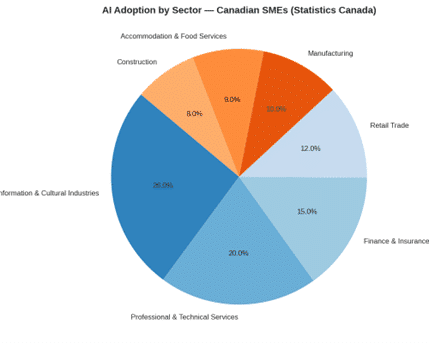
Figure 1: Sector-Specific Pie Chart Regarding AI Adopted by SMEs Across Canada (2025)
What does the above sector-specific pie chart represent?
Sectors Included with Statistics Canada‑Aligned Adoption Shares
- Information & Cultural Industries — 26.0%
- Professional, Scientific & Technical Services — 20.0%
- Finance & Insurance — 15.0%
- Retail Trade — 12.0%
- Manufacturing — 10.0%
- Accommodation & Food Services — 9.0%
- Construction — 8.0%
The aforementioned values reflect the relative distribution of SMEs using AI across sectors, based on Statistics Canada’s analysis and findings released in June 2025. Those findings are corroborated by the Research & Economic Analysis Report from the Canadian Federation of Independent Business (CFIB), entitled Digital Transformation: How Small Businesses in Canada are Leveraging AI and Technology for Growth and Productivity, published in September 2025. The CFIB is a pan-Canadian organization with over 103,000 registered members. Below are the investments made by SMEs on digital technology and AI adoption.
Illustration Approved for Public Release & Free Publication Without Charges: Courtesy of Statistics Canada
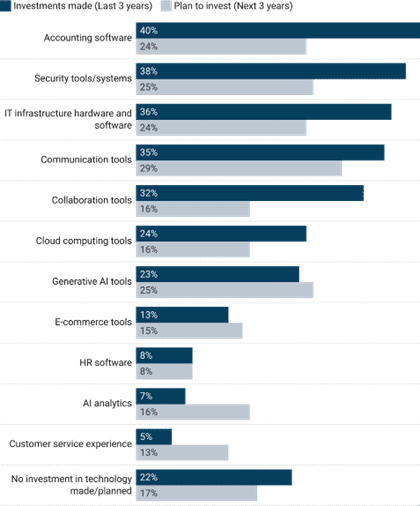
Figure 2: Bar Chart of Investments Made by SMEs on Digital Technology and AI Adoption
Stemming from the above bar chart, we observe that Canadian SMEs are progressively adopting AI in their business operations. On the basis of the above-mentioned data, what cybersecurity best practices should Canadian SMEs apply to better protect their daily business assets and clients?
Source: CFIB, Survey on Digital Technology and AI Adoption, April 24-June 6, 2025, n = 2,446 n = 2,414. Illustration Approved for Public Release & Free Publication Without Charges: Courtesy of the Canadian Federation of Independent Business (CFIB)
Our Cybersecurity Newsletter has been carefully written to answer this proactive question. Indicated at the end of this document, the Resources and References 1 to 25 have been duly accessed, attentively dissected, expansively condensed and thoroughly adjusted for the writing of the 5 Modules of this cybersecurity document integrating pragmatic steps for in-house AI systems.
Recommandations From the Canadian Centre for Cyber Security
To specifically protect an organization against the unique threats posed by Artificial Intelligence, cybersecurity practices must evolve. Canadian SMEs face a two-front challenge: preventing the misuse of AI by employees (which can leak sensitive client data) and defending against AI-driven threats from malicious actors.
The Canadian Centre for Cyber Security (CCCS) structures its guidance around securing AI engineering, model integrity, and user business processes. Implementing an AI-specific protection strategy requires several critical actions:
1. Eliminate “Shadow AI” and Govern Tool Usage
Employees frequently paste proprietary company data or sensitive client information into public generative AI tools (like ChatGPT or Copilot) to draft emails or summarize documents. Once submitted, that data may become part of the public model’s training dataset, leading to severe privacy breaches.
- Map the Network: Audit your network to identify all sanctioned and unsanctioned AI models operating within your business environment.
- Implement Acceptable Use Policies: Create a strict internal policy defining which AI tools are approved and what data types (e.g., source code, client PII, financial reports) are strictly barred from public AI prompts.
- Deploy Data Loss Prevention (DLP): Use DLP software and “secret scrubbing” tools to automatically detect and block employees from uploading corporate API keys, passwords, or Canadian client data into AI platforms.
2. Protect Against Adversarial AI and Prompt Injection
If your SME is building, customizing, or hosting its own AI applications or customer-facing chatbots, those systems become highly attractive targets for specialized cyber attacks.
- Defend Against Data Manipulation: Malicious actors use model inversion and membership inference attacks to query an AI model until it reveals the sensitive underlying data used to train it. Secure your infrastructure by using API rate-limiting and strictly monitoring query patterns for automated mass extraction.
- Isolate AI Systems (Network Segmentation): Do not let your AI tools directly interact with your core databases. Segment internal networks so that if an AI application or chatbot is compromised via a malicious “prompt injection” attack, the threat actor cannot pivot into your primary corporate environment.
- Maintain an AIBOM: Just as software uses a Bill of Materials, maintain an AI Bill of Materials (AIBOM). Track the exact libraries, supply chains, and training datasets used to build your AI tools to catch vulnerabilities quickly when vendor components are updated.
3. Elevate Authentication to Fight AI Spoofing
Traditional identification methods are failing because cybercriminals now use generative AI to orchestrate hyper-realistic text, voice, and video deepfakes to execute Business Email Compromise (BEC) and wire fraud.
- Mandate Phishing-Resistant MFA: Move away from SMS-based or basic push-notification MFA, as AI-automated social engineering can easily bypass them. Enforce hardware security keys (like YubiKeys) or system-level passkeys.
- Enforce Out-of-Band Verification: Implement a strict, non-negotiable protocol for high-risk corporate actions (such as changing client banking details or executing wire transfers). Any request—even if it comes via a voice or video call from an executive—must be verified through a secondary, independent communication channel.
- Set Identity as “Untrusted” by Default: Train finance and administrative staff to treat all unverified identity signals (like sudden executive requests via WhatsApp or unexpected video calls) as untrusted until validated through internal cryptographic or pre-arranged protocols.
4. Prepare for a Faster Patching Cadence
The CCCS warns that the widespread adoption of AI by cybercriminals has triggered a “vulnerability patch wave.” Because threat actors use AI to find software vulnerabilities and code exploits in minutes rather than days, security vendors are releasing fixes at a frantic pace.
- Shorten Patch Testing Windows: Adjust your internal IT risk tolerance. Reduce the length of time spent testing updates before deployment to ensure exposed, edge-facing systems are patched almost immediately after a vendor patch is released.
Decommission Technical Debt: Quickly phase out legacy software or older equipment that vendors no longer update. AI-driven automated search bots scan the internet continuously, seeking out these unpatchable Canadian SME assets.
Protecting your Ai Ecosystems
The objectives of this section is to:
- Understand AI as an interconnected ecosystem rather than isolated tools
- Identify cross‑cutting cybersecurity risks that span all AI ecosystems
- Apply unified security controls across data, models, pipelines, identities, and integrations
- Build an AI governance framework suitable for SMEs
- Integrate AI into existing cybersecurity, compliance, and incident‑response programs
- Implement a practical, SME‑ready AI security roadmap
AI in SMEs is rarely a single tool. It is an ecosystem made of:
- AI‑assisted development tools
- RPA bots
- Chatbots and voice bots
- Recommendation engines
- Integrations with CRMs, ERPs, HR systems, cloud platforms
- Data pipelines, APIs, and storage layers
This AI ecosystem can create shared cyberattack surfaces:
- Data leakage
- Identity compromise
- Supply chain vulnerabilities
- Prompt injection
- Model manipulation
- Misconfigured permissions
- Insecure integrations
Securing AI requires a system‑wide approach, not only tool‑by‑tool fixes.
The 5 PILLARS of AI Ecosystem Security
The AI ecosystem is inherently complex, spanning data pipelines, model architectures, deployment infrastructure, and end-user interfaces. Because threats can emerge at any of these vectors, fragmented security is no longer viable. These pillars establish a unified defense.
PILLAR 1 — Safeguard the AI Supply Chain
AI tools are now part of your software supply chain.
What Should SMEs Do?
- Vet AI vendors for SOC 2 Type 2/ISO 27001 certifications
- Require clear data‑handling policies
- Ensure tools do not train on your data unless explicitly approved
- Maintain an inventory of all AI tools and models
- Use SBOMs (Software Bills of Materials) for AI‑generated code and dependencies
Why Does It Matter?
A compromised AI vendor or model can compromise your entire business.
PILLAR 2 — Secure Data Across Its Entire Lifecycle
AI systems rely on data and cyber-attackers target it.
What Should SMEs Do?
- Classify data (public → internal → confidential → restricted)
- Apply encryption in transit and at rest
- Mask or tokenize sensitive fields
- Restrict what data can be used in prompts
- Log all data access and transformations
- Apply PIPEDA, GDPR, NIS2, HIPAA, PCI DSS where applicable
Why Does It Matter?
Because data is the fuel of AI, SMEs should protect it from end to end.
PILLAR 3 — Secure Identity, Access & Permissions
AI systems often act on behalf of users or entire departments.
What Should SMEs Do?
- Enforce SSO + MFA everywhere
- Apply least‑privilege access for bots, models, and pipelines
- Use role‑based access control (RBAC)
- Assign unique identities to bots and AI agents
- Rotate credentials and store them in secure vaults
Why Does It Matter?
Identity is the new perimeter, especially in AI‑driven automation.
PILLAR 4 — Secure Integrations, APIs & Automations
AI systems rarely operate alone: they connect to everything.
What Should SMEs Do?
- Use secure APIs with OAuth2 or signed tokens
- Validate all inputs and outputs
- Never hardcode credentials
- Monitor API usage for anomalies
- Segment networks for AI workloads
- Apply guardrails to prevent unsafe actions
Why Does It Matter?
Most AI breaches occur through integrations, not the AI model itself.
PILLAR 5 — Secure AI Behavior & Outputs
AI can be manipulated — or simply make mistakes.
What Should SMEs Do?
First and foremost, SMEs should focus on the training of data: prioritize high‑quality, diverse, well‑labeled, and legally compliant data that accurately represents real‑world scenarios to ensure reliable, fair, and scalable AI model performance. Secondly, SMEs should:
- Implement guardrails and policy‑based controls
- Detect prompt injection attempts
- Validate AI outputs before execution
- Use adversarial testing for models
- Monitor for hallucinations, bias, or unsafe recommendations
- Apply human‑in‑the‑loop for high‑risk actions
Why Does It Matter?
AI is powerful but not infallible.
Unified AI Security Controls
The following checklist is useful for the daily operations of SMEs.
Access & Identity
- MFA + SSO everywhere
- Unique identities for bots and AI agents
- Least‑privilege access
Data Protection
- Classification
- Encryption
- Masking
- Retention limits
AI Models Security
- Adversarial testing
- Rate limiting
- Differential privacy
- Monitoring for drift
Pipeline Security
- Secure APIs
- Schema validation
- Logging
- Feature store protection
AI‑Specific Cyberthreats
- Prompt injection defense
- Supply chain scanning
- Dependency allowlists
- Guardrails for unsafe actions
Governance
- AI usage policy
- Inventory of all AI tools
- Risk assessments
- Compliance mapping
Incident Response Plans
- AI misuse scenarios
- Data leakage via prompts
- Compromised integrations
- Model rollback procedures
Roadmap Template for Protecting AI Ecosystems
PHASE 0 — Preparation & Scoping
Objectives
- Establish scope of AI systems (GenAI, ML models, agentic systems).
- Define business goals, risk appetite, and compliance obligations.
Key Activities
- Identify stakeholders (CISO, data owners, engineering, legal).
- Define AI use cases and categorize by risk level.
- Establish initial data classification rules for AI usage.
- Approve interim AI acceptable‑use guidelines.
Deliverables
- AI Ecosystem Scope Document
- Data Classification Policy
- AI Acceptable Usage Policy
PHASE 1 — Discovery & Assessment
Objectives
- Achieve full visibility of all AI ecosystems, including shadow AI.
- Assess risks across identity, data, model, and operational layers.
Key Activities
- Inventory all AI models, agents, APIs, and integrations.
- Map data flows and identify sensitive data exposure.
- Conduct AI‑specific threat modeling (prompt injection, model misuse, data leakage).
- Perform AI risk assessment using standardized checklists.
Deliverables
- AI Ecosystem Inventory & AI‑BOM
- Threat Model & Risk Assessment Report
- Shadow AI Discovery Report
PHASE 2 — Governance & Policy Foundation
Objectives
- Establish governance, approval workflows, and security standards.
Key Activities
- Create AI governance framework (roles, responsibilities, approval gates).
- Define model lifecycle policies (training, deployment, monitoring, retirement).
- Establish vendor evaluation criteria for external AI services.
- Define incident response procedures for AI‑related events.
Deliverables
- AI Governance Framework
- AI Security Policies (access control, data handling, model usage)
- AI Vendor Security Evaluation Scorecard
- AI Incident Response Plan
PHASE 3 — Architecture & Technical Controls
Objectives
- Build a secure, resilient AI architecture.
Key Activities
- Implement zero‑trust architecture for AI ecosystems.
- Deploy isolation/sandboxing for agentic AI.
- Enforce encryption, rate limiting, and resource quotas.
- Establish secure communication protocols for model‑to‑model and agent‑to‑tool interactions.
- Integrate AI‑specific security modules (prompt injection filters, model drift detection).
Deliverables
- Secure AI Architecture Blueprint
- Security Controls Catalog
- Model Security Testing Procedures
PHASE 4 — Implementation & Hardening
Objectives
- Deploy controls, harden systems, and operationalize monitoring.
Key Activities
- Configure authentication/authorization for all AI components.
- Harden model hosting environments and pipelines.
- Deploy monitoring for drift, anomalies, and misuse.
- Integrate logs into SIEM with AI‑specific alerts.
Deliverables
- Hardened AI Infrastructure
- Monitoring & Logging Framework
- AI Security Dashboard
PHASE 5 — Continuous Operations & Improvement (Ongoing)
Objectives
- Maintain resilience, adapt to new threats, and ensure compliance.
Key Activities
- Conduct periodic red‑teaming for AI ecosystems.
- Review model performance, drift, and hallucination rates.
- Update policies and controls based on incidents and audits.
- Train employees on safe AI usage and emerging risks.
Deliverables
- Quarterly AI Security Review
- Updated AI Risk Register
- Annual AI Governance Report
Knowledge Assessment – Quiz (Answers below) – Quiz
(Answers below))
1. What is the most common cross‑system AI risk?
A. GPU overheating
B. Insecure integrations
C. Slow model training
D. Lack of cloud storage
2. Why must bots and AI agents have unique identities?
A. To reduce licensing costs
B. To enable auditability and access control
C. To improve performance
D. To simplify workflows
3. Which PILLAR focuses on preventing prompt injection?
A. Data lifecycle security
B. Supply chain security
C. AI behavior & output security
D. Identity management
Summary
AI security is not about securing individual tools — it is about securing the entire AI ecosystem. Consequently, SMEs must protect:
- Data
- Models
- Pipelines
- Identities
- Integrations
- AI behavior
- Governance
When these controls are unified, SMEs can safely adopt AI at scale, unlocking productivity, efficiency, and innovation without exposing themselves to unnecessary risk.
The answers to the Quiz are: B, B, C
Conclusion
What are the current trends pertaining to AI exploited by Canadian SMEs?
Canadian SMEs are nowadays gradually implementing AI adoption – driven by productivity pressures, government incentives, and the falling cost of cloud‑based AI tools. The latest Canadian sources point to rapid uptake, strong interest in generative AI, and targeted federal programs designed to close the SME productivity gap.
1. AI Adoption Is Surging Among Canadian SMEs
- 71% of Canadian SMEs are now using AI or generative AI, with adoption reaching 90% among digital‑native firms.
- Nearly 75% plan to increase AI investments, and 63% specifically plan to increase GenAI spending.
- AI is no longer experimental—SMEs are operationalizing it across core business functions.
Determining Drivers:
- Tight margins
- Labour shortages
- Productivity pressures
- Need for automation and faster decision‑making
2. Practical, High‑Value Use Cases Dominating SME Adoption
According to NOVIPRO’s national IT Trends report:
- In the wake of cloud computing, 30% of Canadian companies plan to invest in AI during the upcoming two years.
- SMEs are adopting AI for customer experience, demand forecasting, automation, and cost reduction.
Top real-world applications:
- AI assistants and chatbots for customer services management
- Predictive analytics for demand and inventory
- Automation of repetitive tasks
- Personalized recommendations for e‑commerce
- Document processing & translation (GenAI)
53% of companies around the world are investing in AI to boost productivity; 41% to cut costs.
3. AI as a Productivity Engine
Canadian SMEs using digital tools—including AI—see:
- 29% average productivity boost
- $1.60 return for every $1 invested
- 1.08 hours saved per day per generative AI application
- Potential $12.8B annual GDP boost if time savings are reinvested productively
This aligns with the broader national goal of closing Canada’s productivity gap.
4. Strong Federal Government Push to Accelerate SMEs AI Adoption
The Government of Canada launched major programs to support SME AI adoption:
- $200M Regional Artificial Intelligence Initiative (RAII) to accelerate SMEs AI adoption across multiple sectors.
- $100M AI Assist Program to help SMEs build or integrate generative AI and deep learning solutions.
Relevant hyperlink for accessing the above programs: Regional Artificial Intelligence Initiative – Canada.ca
These are part of a $2.4B national AI package (Federal Budget 2024) aimed at productivity, job growth, and responsible AI usage.
5. Global Alignment: G7 SME AI Adoption Blueprint
During the 2025 G7 Meeting in Montreal, international ministers emphasized:
- The need for secure, responsible, trustworthy AI for SMEs
- Building SME‑friendly AI ecosystems
- Supporting SMEs with skills, compute access, and integration support
This positions Canada as an active leader in shaping global SMEs AI adoption standards.
6. Sector‑Specific Momentum: Manufacturing Leads
NGen announced $79.5M in new AI projects to help Canadian manufacturers adopt AI for:
- Quality control
- Safety
- Reducing downtime
- Commercializing Canadian AI innovations
Manufacturing is becoming a flagship sector for applied AI in Canada.
Resources and References
- Government of Canada – Statistics Canada – Analysis in Brief. Analysis on artificial intelligence use by businesses in Canada, second quarter of 2025
- Canadian Federation of Independent Business (CFIB) – 2025 Research and Economic Analysis Report. Digital Transformation: How small businesses in Canada are leveraging AI and technology for growth and productivity
- Government of Canada – Innovation, Science and Economic Development Canada. Federal government launches programs to help small and medium-sized enterprises adopt and adapt artificial intelligence solutions – Canada.ca
- Amanda Downie & Matthew Finio. International Business Machines (IBM). AI in Software Development | IBM
- Anish Bandhi. American Journal of Engineering Research (AJER). A Review on Using Artificial Intelligence in Software Development. 14073033.pdf
- Mamdouh Alenezi & Mohammed Akour. Multidisciplinary Digital Publishing Institute (MDPI). AI-Driven Innovations in Software Engineering: A Review of Current Practices and Future Directions
- McKinsey & Company. Technology, Media & Telecommunications. Unlocking the Value of AI in Software Development. Leading AI-driven software organizations show the way | McKinsey
- Sadia Afrin, Shobnom Roksana, Riad Akram et al. IEEE Xplore – Digital Library. AI-Enhanced Robotic Process Automation: A Review of Intelligent Automation Innovations | IEEE Journals & Magazine | IEEE Xplore
- Osvaldo Braz dos Santos Moderno, Antonio Carlos Braz & Paulo Trombino de Souza Nascimento. Emerald Insight – Business Process Management Journal. Robotic process automation and artificial intelligence capabilities driving digital strategy: a resource-based view | Business Process Management Journal | Emerald Publishing
- Siddharta Bhattacharyya, Jyoti Sekhar Banerjee & Debashi De. Springer Nature Books Publishing. Confluence of Artificial Intelligence and Robotic Process Automation | Springer Nature Link
- Paula Williams. International Business Machines (IBM). Artificial Intelligence for Robotic Process Automation | IBM
- Google Cloud Platform (CGP). Conversational AI documentation | Google Cloud Documentation
- Siddhant Meshram, Namit Naik, Shubhangi Kharche et al. IEEE Xplore – Digital Library. Conversational AI: Chatbots | IEEE Conference Publication | IEEE Xplore
- Girija Chiddarwar, Samruddhi Bhabad, Aaditi Indalkar et al. IEEE Xplore – Digital Library. Advancements in Conversational AI: A Survey of Chatbots and Voice Assistants | IEEE Conference Publication | IEEE Xplore
- Carmen Balan et al. Multidisciplinary Digital Publishing Institute (MDPI). Chatbots and Voice Assistants: Digital Transformers of the Company–Customer Interface—A Systematic Review of the Business Research Literature
- Shaina Raza, Mizanur Rahman, Safiullah Kamawal et al. Cornell University – Department of Computer Science – arXiv Org. [2407.13699] A Comprehensive Review of Recommender Systems: Transitioning from Theory to Practice
- Matthew O. Ayemowa, Roliana Ibrahim, Muhammad Murad Khan et al. IEEE Xplore – Digital Library. Analysis of Recommender System Using Generative Artificial Intelligence: A Systematic Literature Review | IEEE Journals & Magazine | IEEE Xplore
- Yang Li, Kanbo Liu, Ranjan Satapathy et al. Cornell University – Department of Computer Science – arXiv Org. [2306.12680] Recent Developments in Recommender Systems: A Survey
- Meena Laad, Ratan Maurya, Najeeb Saiyed et al. IEEE Xplore – Digital Library. Unveiling the Vision: A Comprehensive Review of Computer Vision in AI and ML | IEEE Conference Publication | IEEE Xplore
- Victor Garcia, David Zarilla & Jesus Sanchez-Marquez (Editors). Multidisciplinary Digital Publishing Institute (MDPI). AI | Special Issue : AI and Computer Vision in Real-World and Industrial Applications
- Pan Wu, Xiao Qiang Ye, Wenhao Dai et al. IEEE Xplore – Digital Library. A Review on Research and Application of AI-Based Image Analysis in the Field of Computer Vision | IEEE Journals & Magazine | IEEE Xplore
- G7 SUMMIT 2025. G7 Industry, Digital and Technology Ministerial Statement on the SME AI Adoption Blueprint. G7 Industry, Digital and Technology Ministerial Statement on the SME AI Adoption Blueprint
- Microsoft Corporation – Microsoft News. Majority of Canadian Small and Medium-Sized Businesses Embrace AI, with 71% Actively Using Tools to Drive Efficiency and Growth. Majority of Canadian Small and Medium-Sized Businesses Embrace AI, with 71% Actively Using Tools to Drive Efficiency and Growth – Source Canada
- NOVIPRO. Top 5 Practical Uses of AI Accessible to Canadian SMEs. Top 5 Practical Uses of AI Accessible to Canadian SMEs
- Government of Canada. Regional Artificial Intelligence Initiative (RAII). Regional Artificial Intelligence Initiative – Canada.ca
Contributions
Special thanks for the financial support of the National Research Council Canada (NRC) and its Industrial Research Assistance Program (IRAP) benefitting innovative SMEs throughout the 10 provinces and 3 territories of Canada.
Eligible Canadian innovative SMEs can address their cybersecurity requirements by obtaining financial assistance for compliance readiness and certification audits. If you would like more information about NRC IRAP, please consult: About the NRC Industrial Research Assistance Program or reach out to your NRC IRAP Industrial Technology Advisor.
Newsletter Executive Editor:
Alan Bernardi, SSCP, PMP, Lead Auditor for ISO 27001, ISO 27701 and ISO 42001
B.Sc. Computer Science & Mathematics, McGill University, Canada
Graduate Diploma in Management, McGill University, Canada
Author-Amazon USA, Computer Scientist, Certified Professional Writer & Translator:
Ravi Jay Gunnoo, C.P.W. ISO 24495-1:2023 & C.P.T. ISO 17100:2015
B.Sc. Computer Science & Cybersecurity, McGill University, Canada
B.Sc. & M.A. Professional Translation, University of Montreal, Canada
This content has been prepared to the best of our knowledge. While every effort has been made to ensure accuracy and clarity, we cannot guarantee that all information is complete, error‑free, or up to date. The views and information provided are intended for general purposes only.
This content is published under a Creative Commons Attribution (CC BY-NC) license.